
A short intermediate level English resource.
CLOSE ENCOUNTERS with a Twister
Tornado ! Paul Denman tells about the day he came face to face with America's most frightening meteorological phenomenon
Until last year, I'd always wanted to see a
tornado. A few years ago, in Oklahoma, I saw one of those violent dark
green storm skies, with small 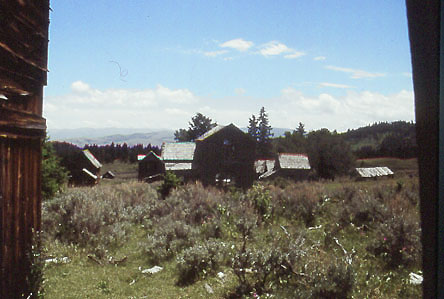 conesfunnel-shaped
cloud formations hanging down from its
underside; but the tornado that people feared at that moment never materializedappeared, happened.
The cones were suckeddrawn
back, pulled back into the clouds, and
eventually the sun came out again.
conesfunnel-shaped
cloud formations hanging down from its
underside; but the tornado that people feared at that moment never materializedappeared, happened.
The cones were suckeddrawn
back, pulled back into the clouds, and
eventually the sun came out again.
Then last year I met my first (and thankfully only) tornado.... and it was not in the south. We were in Montana - tranquil old Montana - enjoying our summer vacation, when the twister struckhit suddenly, attacked. The day had begun like any ordinary July day in Montana, with a bright blue sky, and hot sunshine. A few bubbling clouds were blowing across, as we made our waytraveled, proceeded in the footsteps of Calamity Jane, towards an ancient mining town called Castle. In the days when the West was Wild, Castle was a roughviolent, disorderly and busy town, full of miners looking for silver and gold. Jane stayed there for a few years, runningmanaging, operating a bar. Today, Castle is a "ghost town", a collection of old wooden buildings, some still standing, others just a pile of fallen boardswooden planks and planks of wood. Abandoned over 100 years ago, when the mines ran out ofexhausted the supply of precious metals, Castle now lies in the middle of nowhere, miles from a paved road, miles from civilisation.
That morning, Castle was deserted. Few visitors make the journeytravel, visit to this distant part of Montana, and even fewer want to drive ten miles on a dirt-trackunpaved road to visit a place like Castle. The sun was shining brightly when we arrived, and it was still shining when we found the house where Jane used to live. It wasn't until the sun went behind a cloud that we looked up at the sky.
"Hey!" said Sarah, "Look, there's a storm coming..." Indeed, to the south, the sky had turned an inkydark, black as ink black. A storm was coming, and it looked like a big one.
"Let's get back to the main road," Sarah added. "These tracks will be unpassable if there's a storm."
"Sure, that's a good idea, let's get going!leave now" I said.
"If we go north, we'll come out near White Sulphur Springs," said Robbie.
The track woundtwisted and turned upwards through a forest of pine trees, then divided, then divided again.
"Which way?" I asked.
"Take the track to the right," said Julie who had the map.
"Are you sure?"
"No, I'm not sure exactly where we are... the map doesn't show all these tracks... but I think so."
The time was just about midday, yet somehow, in the space of ten minutes, all the blue had vanished from the sky, and the light was fadingdisappearing, growing dark fast, as if evening was coming on. The track twisted and turned, up and down, through woods and over streams, and then, at last, out onto an open, treeless, hilltop. Suddenly Sarah shouted. "Look, a tornado!"
I pulled the car to a stop, and looked back; and there it was.
Just like in the movie: the clouds were hanging like a dark ceiling
above our heads, slate graydark grey like slate stone
with tinges of brown and green. And there, just a few miles to the
south, was the tornado, an inky funnel of twisting cloud coming right
down to the ground. Beside it, several other menacing cones were
hanging downwards, ready to strike. We could see them moving in our
direction. 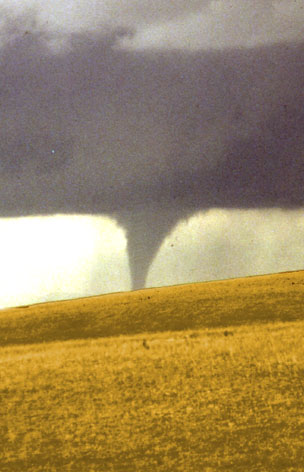 "Let's get out of here!" I
said, and threw the car into gearengaging the engine to drive.
"Let's get out of here!" I
said, and threw the car into gearengaging the engine to drive.
I don't usually drive cars at 50 m.p.h along dirt tracks, but this time I did; as we speddrove very fast across the open hilltop, it seemed like there were three different storms coming towards us at once, from three different directions. By now we could see waves of wind gustingblowing in sudden strong bursts across the grassland, and by the time we reached the trees again, branches were blowing in all directions. Then, beside the track, we came across a group of tourists on quad bikesfour-wheeled off-road vehicles, enjoying a cross-country trip. We stopped the car for a moment to warn them, but the tour-guide laughed. "Tornado?! Nah! We don't get tornados here!" I wasn't going to hang aroundwait, linger arguing with him, so we just set offstarted moving again, hoping to find a real road where we could move faster than the storm. But it was not to be. We had come out of the woods, and were going down into a valley when suddenly the hills in front of us vanished. It all happened in the space of about two minutes.
"It's coming this way," shouted Sarah.
"Find some shelterprotection from the weather!" said Julie.
There was none - not a tree, not a building, not a bridge, until, just as we were giving uplosing hope, like a mirage in the desert, we spottedsaw, noticed an old abandoned church. Just beyond it, the sky seemed to touch the ground. As we raced towards the shelter of this - probably the most solid building for miles around - the first hailstonesballs of ice falling as rain hit us, as big as golf balls, blowing almost horizontally across the windscreenfront window of a car. We reached the church, and pulled to an abrupt halt. Shelter! By then we could see nothing - or at least nothing further from us than about fifteen meters; and although there were four of us in the car, and it was a heavy car too, the vehicle was jumping up and down on its springssuspension system, as if someone was trying to push it over. The noise of the wind and the hailstones on the roof was deafeningextremely loud, and conversation was impossible, so we just sat there in silence hoping and praying that our car was not going to be picked up like a leaf, and thrown across into the unknown that we could not see.....
It probably lasted about ten minutes - but sitting in that bumping noisy car, it seemed more like ten hours until, almost as suddenly as it had started, the wind stopped, and the hail stopped falling. Normality returned.
"Phew!", said Sarah. "I thought we'd had it!we were going to die"
"Me too," said Robbie.
Fortunately, the tornado had missed us, and we'd just been through the very violent storm that accompanied it. But just short distance down the road, the twister had caused chaos and destruction, flattening a farm and a garage as it rolled across the prairies of Montana. A week later, a similar twister crashed into a camp ground in Alberta, Canada, killing a dozen people, and wreckingdestroying hundreds of tents and caravans. With hindsightlooking back after the event, I felt that we'd been quite lucky. I'd seen my twister, I'd been on the edge of it, but fortunately not in the middle. Frankly, that was quite enough.
TORNADO ALLEY
Perhaps you saw the movie "Twister". Remember, it was the film about scientists who wanted to measure the forces in the middle of a tornado. It was a frightening movie, which illustrated the incredible strength of this terrifying natural phenomenon. Though small tornados can happen in many parts of the world, it is only in North America that the real big "twisters" attack. "Tornado Alley" stretches from the Gulf of Mexico in the south, as far as the plains of Alberta, Canada, in the north. The further north you go, the rarer they are; but in the southern states of Texas, Kansas and Oklahoma, Tornados strike every year, destroying houses and mobile homes, cars and trees, and anything else that gets in their way.
TORNADO ALLEY
Perhaps you saw the movie "Twister". Remember, it was the film about scientists who wanted to measure the forces in the middle of a tornado. It was a frightening movie, which illustrated the incredible strength of this terrifying natural phenomenon. Though small tornados can happen in many parts of the world, it is only in North America that the real big "twisters" attack. "Tornado Alley" stretches from the Gulf of Mexico in the south, as far as the plains of Alberta, Canada, in the north. The further north you go, the rarer they are; but in the southern states of Texas, Kansas and Oklahoma, Tornados strike every year, destroying houses and mobile homes, cars and trees, and anything else that gets in their way.
Notes:
Calamity Jane
Jane was one of the very few women who became famous in the very masculine world of the Wild West. She was really Martha Jane Burke, 1852-1903. She spent most of her life in mining towns of South Dakota, and working on the wagon trains that brought supplies to the wild and isolated towns. She was an excellent shot with a revolver or a rifle.The
days
when the
West was Wild:
Generally, the second half of the
nineteenth century, as
the new territories, between the Mississippi and the Pacific, were
opened up. In particular, the short period between about 1850 and 1880,
the "heyday" of the legendary West.
Printing: Optimized for printing
Copyright © Linguapress. Do not copy this document to any other website
Copying permitted for personal study, or by teachers for use with their students
Close Encounters with a Tornado - Worksheet
Exercise 1:
Interactive gap-fill exercise. Use on screen or on paper : prepositions
Fill in the missing prepositions in this extract . You will find a list of the missing prepositions in the left hand column. The number indicates how many times each one is needed. (To save your answers, take a screenshot when you have made your choices)| List
of missing prepositions to replace:
About: 3 , above 1, across 4, along 1 , at 4, beside 2, beyond 1, by 3, down 3, for 2, from 3, in 7 , into 1, of 10, off 1, on 2, out 3, over 1, through 1, to 10, towards 2, up 2, with 2, |
The
time was just midday, yet
somehow, the
space ten minutes, all the blue had vanished the sky,
and
the light was fading fast, as if evening was coming . The track twisted and turned, and , woods and streams, and then, last, onto an open, treeless, hilltop. Suddenly Sarah shouted. "Look, a tornado!" I pulled the car a stop, and looked back; and there it was. Just like the movie: the clouds were hanging like a dark ceiling our heads, slate gray tinges brown and green. And there, just a few miles the south, was the tornado, an inky funnel twisting cloud coming right the ground. it, several other menacing cones were hanging downwards, ready strike. We could see them moving our direction. "Let's get here!" I said, and threw the car gear. I don't usually drive cars 50 m.p.h dirt tracks, but this time I did; as we sped the open hilltop, it seemed like there were three different storms coming us once, three different directions. now we could see waves wind gusting the grassland, and the time we reached the trees again, branches were blowing all directions. Then, the track, we came a group tourists quad bikes, enjoying a cross-country trip. We stopped the car a moment warn them, but the tour-guide laughed. "Tornado?! No! We don't get tornados here!" I wasn't going hang around arguing him, so we just set again, hoping find a real road where we could move faster than the storm. But it was not be. We had come the woods, and were going a valley when suddenly the hills front us vanished. It all happened the space two minutes. "It's coming this way," shouted Sarah. "Find some shelter!" said Julie. There was none - not a tree, not a building, not a bridge, until, just as we were giving hope, like a mirage the desert, we spotted an old abandoned church. Just it, the sky seemed touch the ground. As we raced the shelter this - probably the most solid building miles around - the first hailstones hit us, as big as golf balls, blowing almost horizontally the windscreen. We reached the church, and pulled an abrupt halt. Shelter! then we could see nothing - or least nothing further us than fifteen meters. |
Exercise 2:
Read the article, and decide which of the three alternatives suggested is the best synonym for the following words or phrases:
- Eventually .
- Funnel
- At once
- We came across
- Warn them
- It lasted
Exercise 3:
Make up eight questions that you would like to ask Sarah, using eight different structures or questions words, including two from each of these groups:
* Group 1: Questions with NO question word.
* Group 2: Questions with how much or how many.
* Group 3: Questions with how often, how long, or how + adjective.
* Group 4: Questions with what, where, how, when or why.
Imagine Sarah's reply in each case.
Exercise 4:
Teachers, a) using exercise 3 as a starting point, have students script an imaginary interview involving Sarah or Paul and a radio reporter; this interview can be acted out in class, or recorded.
b) Note tense usage in this article, notably use of the past perfect (with had). this is only used in English, when it is necessary to place one action or event further in the past (i.e.before) than another that is mentioned.
Until (i.e.before) last year (past event), I HAD always wanted to see a tornado.
Grammar point - the present participle and -ing forms
This text is very rich in -ing forms – words like hanging, enjoying, bubbling, blowing. Most of the examples in this text are present participles (on their own, or indicating a continuous verb form), and there is only one verbal noun in -ing and that is building.The past progressive tense: In particular, this text has over a dozen examples of verbs used in the continuous or progressive aspect, most frequently in the past progressive tense, as in A few bubbling clouds were blowing across.
For a full explanation of -ing forms with lots of examples, see Gerunds and -ing forms in A Descriptive Grammar of English, section 1.9.
Further suggestions submitted by Annette Engelmann, from Switzerland.
A/ Find the synonyms (look only at the bold and italicized words)
To go
To have no more of
Four-wheeled motor scooters
Protection
To appear, become real
B/ Answer the following questions about the text (full sentences, please)
1. What was the weather like when Paul Denman experienced a tornado in
Castle? Explain the development of the weather.
.......................................................................... ..............................................................................
......................................................................... ...............................................................................
......................................................................... ...............................................................................
........................................................................ ............
2. How many people were there in the car? Give the names.
....................................................................... ................................................................
3. What were the reactions of the various people in the car?
....................................................................... .................................................................................
....................................................................... .................................................................................
....................................................................... ..............................
4. Who and what saved them?
....................................................................... .................................................................................
....................................................................... ...............................................
C/ Your opinion (number of words is the minimum expected)
1. What do you think happened to the group of tourists? (30 words )
...................................................................... ..................................................................................
....................................................................... .................................................................................
....................................................................... .................................................................................
....................................................................... .............
2. How do you think you would react in a similar situation? (30 words)
...................................................................... ..................................................................................
....................................................................... .................................................................................
..................................................................... ...................................................................................
..................................................................... ...............
3. Do you think anything like this could happen in your country? Why (not)? (25 words)
...................................................................... ..................................................................................
...................................................................... .................................................
Other ideas?
EFL teachers: Help develop this resource by contributing extra teaching materials or exercises.
To contribute click here for further details
Reading comprehension in the English class
(Version française : Petite méthodologie de la compréhension écrite )
| Linguapress; home | Découvrez l'Angleterre (en français) | Discover Britain |

