
There are still prospectors searching for gold in the American Far West
GOLD has always attracted people. At the start of the twentieth century, and during the nineteenth century, thousands of men went to the West of the United States, looking for gold. The "Gold Rush" lasted, on and off, for, sixty or seventy years, then it finished.But today, there are still a few men and women out in the West, looking for gold, as Andrew Rossiter found out.
 It
was a blistering
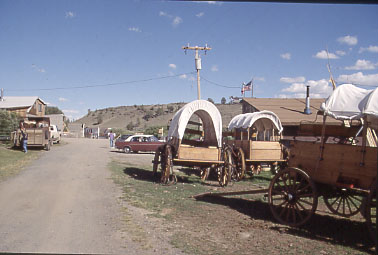
hot day in summer. The track leading to "Atlantic City" (Wyoming) was
dry
and bumpy, and great clouds of dust blew up behind the car. In 1870,
Atlantic
City was a prosperous town, with several thousand inhabitants, mostly
men.
It was a strange place to find a town, mind
you,
hidden in a little
gulch
in the middle of a wide
scrub
desert.
It
was a blistering
hot day in summer. The track leading to "Atlantic City" (Wyoming) was
dry
and bumpy, and great clouds of dust blew up behind the car. In 1870,
Atlantic
City was a prosperous town, with several thousand inhabitants, mostly
men.
It was a strange place to find a town, mind
you,
hidden in a little
gulch
in the middle of a wide
scrub
desert.
Atlantic City began life as a staging post on one of the transcontinental trails, taken by emigrants en route for California. Soon however it became a roaring gold town, where people could make (or lose) their fortunes in a day. Few of them made a fortune; a few found enough gold to keep them happy, but many found nothing, or nothing much.
Then, about seven years after the gold rush began, it finished. Suddenly, it seemed that there was no gold left in the ground. Most of the miners packed their tools, their pans, and their bags, and went off somewhere else, to try their luck again. There were no more emigrants either; as soon as the first transcontinental railroad had opened in 1869, the old emigrant trails had been completely abandoned.The hotels closed, the shops closed, the bars closed, the jail closed; and before long, Atlantic City was a ghost town, uninhabited except by the occasional rancher or hunter, and a few wandering coyotes. I didn't expect to find much in Atlantic City. I knew that a few people lived there again now, some of the old houses had been restored, and others had been built. But I didn't expect much.
We drove round a dusty bend, and there in front of us lay the town, a couple of dozen wooden buildings, some old, some new, and mostly pretty plain.
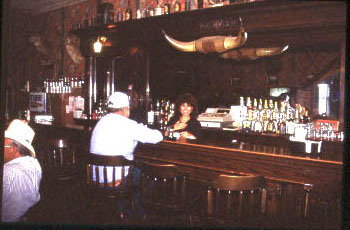
Surprisingly there was a fire-station; then, in the middle of the town, a wooden "saloon". A drink, I thought, something to drink at last.
 I
stopped the car in a cloud
of dust, and we walked up the steps and into the saloon.
I
stopped the car in a cloud
of dust, and we walked up the steps and into the saloon.
Well if I'd wanted to do a bit of time-travelling, I couldn't have done much better; walking through that door was like walking back over a hundred years in time. Inside, the old Western saloon was still intact, with its big long wooden bar, and enormous mirrors on the walls. Apart from the electric light, the juke box, and the tables set for dinner, it was almost perfect.
And
there in the corner sat
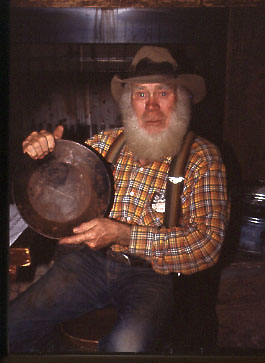
the prospector,
with his wife. If he'd been
wearing a red gown, I'd have taken him for Father Christmas, but he
wasn't.
This old-timer wasn't in Atlantic City to bring presents, but to find
gold.
He
said his name was Brad,
and he'd been looking for gold in Atlantic City for some time now. Yes,
he'd found a little gold – not enough to make him a millionnaire, but
enough
to make him happy.
 When
the Gold Rush ended
in Atlantic City, he told me, it was not actually because there was no
more gold, but because gold was too hard to find, or not valuable
enough.
When
the Gold Rush ended
in Atlantic City, he told me, it was not actually because there was no
more gold, but because gold was too hard to find, or not valuable
enough.
Today, gold is a lot more valuable than it was a hundred years ago, and modern techniques allow people to find gold more easily. And that was why Brad and his wife were in Atlantic City, digging for gold.
They were not the only ones, said Brad; quite a few of the "concessions" are now being worked, and some old mines are being opened up again. In some places, mining for gold has become commercially profitable again; but in most cases, the miners, like Brad, are just amateurs.
No, Brad hadn't spent all his life digging in tunnels and panning in streams, to find a few ounces of gold. In fact, he was a retired businessman, looking for gold as a hobby, and a nice way to pass the time in a wild, lonely and beautiful part of North America.
More than gold, no doubt, Brad was looking for a way of life, a dream of the past. If he had found no gold, he would not have been too worried. Few of today's amateur gold prospectors are there for the money; most are there for the fun, the isolation, and the nostalgia!. The legend of the west will go on inspiring people for many many years.

Bend: corner- Blistering: very hot - en route for: going to - expect: think that - gulch: valley - jail: prison - mind you: please note - on and off: from time to time - ounces: grammes (1 ounce = about 25 grammes) panning: looking - plain: ordinary - prospector: person looking for gold - retired: a person retires when he/she stops her working life - roaring: very active - scrub: small bushes - staging post: place where people stopped for the night, bought provisions, etc. - trails: tracks - worried: anxious
Printing: Optimized for printing
Copyright © Linguapress. Do not copy this document to any other website
Copying permitted for personal study, or by teachers for use with their students
Still looking for gold - Classroom ideas
Grammar points 1: Indirect speech. Note how most of the latter part of the article mostly reports information given by Brad. Students should pick out the ways in which the writer shows that this is all reported speech.
Grammar points 2: This text is rich in quantifiers : much, many, few, a few, some enough and others. Note particularly the uses of much and many, few and a few. For a full and clear exploration of quantifiers, see the Linguapress Descriptive Grammar of English, available as an ebook or paperback from Amazon.
Follow-up exercises and activities
1. Telling the story. Students should read through the article, then try to write a third person account based on the events narrated in the article.
2. Complete the dialogue:
An interactive exercise that can be completed by students on their computers; students can then print out their dialogues foir correcting by the teacher. This exercise is in its own file.
More.... Jump to ► Looking for Gold - interactive exercise
Other ideas?
EFL teachers: Help develop this resource by contributing extra teaching materials or exercises.
To contribute click here for further details
Reading comprehension in the English class
(Version française : Petite méthodologie de la compréhension écrite )
© linguapress.com