
WITH AUDIO ►: Click to open/close audio player
Who was Buffalo Bill ?
Discovering an American folk hero ......
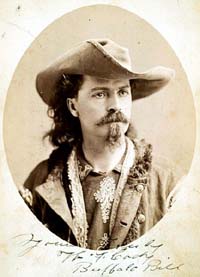 Buffalo Bill Cody was born on a farm in Scott
county, Indiana, on 26th
February 1846.
Buffalo Bill Cody was born on a farm in Scott
county, Indiana, on 26th
February 1846.
In those days, life in the American West was a constant struggle for survival, and native Americans and white pioneers would fight to the death to protect their homes and their people.
Clearly, young Bill was a tough boy, who knew what he was doing. Before he was thirteen, he was an expert horse-rider and very good with a gun; and in those days, when the West was wild, that meant he had excellent qualifications for a job.
Before the age of twenty, Bill left home and took a job with the Pony Express company, and very soon he became reputed as one of their best riders.
It was the time when the West was being opened up. After the Pony Express, Bill got a job supplying buffalo meat to the men building the Kansas Pacific rail-road. In the space of 17 months, he claims to have killed 4,280 buffaloes. This is where he got his name, “Buffalo Bill".
In the 1870s, he worked as a scout for the army, during the "Indian campaigns", and took part in General Custer’s war against the Sioux. Once, he killed Chief Yellow Hand in a duel. This was just one of the exploits that were written about in popular story books. In those days, anyone who killed Indians was seen as a hero. It is very different today.
Today, we look at the Indian wars in a different light. Though many American Indians still call themselves “Indians", the expression “native Americans" is considered to be more correct. Huge areas of land have been given back to the Indian nations, and Americans accept that White pioneers stole it from them in the past.
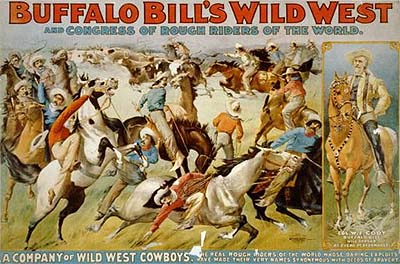 In fact, Buffalo Bill was one
of the first men in modern America to realise that white Americans and
Indians
could, and should, work together. Bill made his peace with the Indians,
and when he established his famous “Wild West
Show", he recruited
many famous Indians to work with him.
They included Red Cloud, Red Shirt, and even Sitting Bull. His grandson
says, “At its height, there were over 650 people who
travelled with the show, including 250 American Indians. With these
Indians, with all the cowboys, they re-enacted
the robbery of the
Deadwood stage coach and the Pony Express mail
relay
system".
In fact, Buffalo Bill was one
of the first men in modern America to realise that white Americans and
Indians
could, and should, work together. Bill made his peace with the Indians,
and when he established his famous “Wild West
Show", he recruited
many famous Indians to work with him.
They included Red Cloud, Red Shirt, and even Sitting Bull. His grandson
says, “At its height, there were over 650 people who
travelled with the show, including 250 American Indians. With these
Indians, with all the cowboys, they re-enacted
the robbery of the
Deadwood stage coach and the Pony Express mail
relay
system".
With the money he earned from his show, Bill purchased some land in Wyoming; but by then the West was already changing dramatically. Bill, the once-great buffalo-hunter looked nostalgically at the few rare buffaloes that were still around, and realised that they had to be protected. At the same time, he began trying to conserve aspects of the old Western life that were rapidly disappearing into the twentieth century. One of the things he did was to help establish America’s first National Forest reserve in Wyoming.
When he died, aged 70, Buffalo Bill knew that the old West was almost dead too, except in history and stories. Yet he knew, too, that one of the most famous names associated with its legends, was his own.
© Linguapress.com
WORDS :

showman: man who runs a show - struggle: fight, battle - survival: existence - pioneer: person colonizing new territory - tough: strong, resistant - ancestor: grandfather and earlier generations - expanse: open space - willing to: ready to, prepared to - supply: bring, provide - claims to have: says he - duel: organised fight between two people - exploit: action - area: zone - recruit: employ - height most important moment - re-enact imitate, play - mail: post - purchase: buy - reserve: protected zone.-
Return to Linguapress site index
Printing: Optimized for A4 printing with the Firefox or Chrome browsers
Copyright © Linguapress. Do not copy this document to any other website
Copying permitted for personal study, or by teachers for use with their students.
Student worksheet
Who was Buffalo Bill ?
For help with the following exercise, check out Forming questions in EnglishExercise:
Here is an imaginary interview with Bill Cody, aged 65; What questions were asked, in order to elicit these answers..
Bill: I was under 20
Reporter : What ................................................ ......................................................... ................
Bill: I got a job providing buffalo meat for the men building the railroad.
Reporter :: How ............................................. ....................................................... ..........................
Bill: Seventeen months
Reporter : Later on ................................................. ........................................................ ....................
Bill: Well, I realised that really we would do better to living and working together, rather than killing each other.
Reporter:What ........................................... ....................................................... ..................................
Bill: I used it to buy myself some land in Wyoming.
Reporter: Do.. ................................................ ......................................................... .................................
Bill: Oh no! I realise now that we ought to be protecting nature, not destroying it!
The audio recording
Note that there are several small differences between the written text above and the version in the audio file. These are deliberate, and serve to show synonyms or different ways of expressing the same thing. Look out for the differences as you listen to the audio file.
Other ideas?
EFL teachers: Help develop this resource by contributing extra teaching materials or exercises.
To contribute click here for further details
This
teaching
resource
is ©
copyright Linguapress renwed 2023
Revised 2015 . Originally published in Freeway,
the intermediate
level
English
newsmagazine.
 Copyright
information.
Copyright
information.
Free to view, free to use in class, free to print, but not free to copy to other websites.
| Linguapress; home | Découvrez l'Angleterre (en français) | Discover Britain |