
Black and British
Focus: An extended intermediate level English resource.
Freeway magazine looks at the story of the Black community in today's Britain.
Section 1 Background.
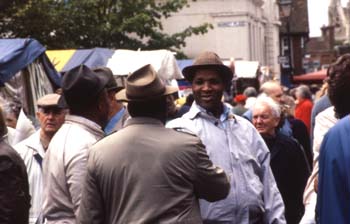 In the nineteen-fifties,
Britain was a nation in need of men. A decade
after the second
world war, it was a country with lots of children, but
not enough men to work in the mines, the factories and the public
services.
In the nineteen-fifties,
Britain was a nation in need of men. A decade
after the second
world war, it was a country with lots of children, but
not enough men to work in the mines, the factories and the public
services. Hundreds of thousands of young men had been killed during the war; who could take their place? There was an easy answer; men from the colonies! Britain was still the capital of an Empire that stretched to the four corners of the earth. In the developing countries of the Commonwealth, there were millions of young men, just looking for work. When the British authorities offered them the chance to come to Britain and work, thousands wanted to come.
Most came without their families; but soon, as they settled into their new country and their new jobs, they paid for their families to come over too. While a few came from Africa, the largest contingent of Black immigrants came from Jamaica and the other islands that make up the West Indies.
By 1960, "Afro-Caribbeans" and their families had settled in large numbers in several of Britain's cities — usually in the poorest and most unattractive parts. At the time however, the conditions they lived in in Britain were not too bad, and often better than those they had enjoyed in the West Indies. There were jobs, so there was money; there were schools for the children.
Thus, with its young families, but few teenagers, the Afro-Caribbean community lived quietly beside the White community in cities like London and Wolverhampton, and there was no tension. In reality, the two communities hardly mixed at all; there was little ethnic rivalry , because generally speaking there were enough jobs for everyone. In many cases, black workers took the jobs that white workers did not want — bus conductors , railway porters, and other jobs that were not too well paid.
Then around 1967, things began to change. Inspired by the Civil Rights movement in America, and encouraged by the liberal ideologies of the sixties, Britain's Blacks began to look for a new identity and a better status for their community. But at the same time, right-wing nationalist movements were starting to develop in some sectors of white society. A former Conservative minister, Enoch Powell, predicted violent conflicts between Blacks and Whites, and called for Britain's Blacks to be sent back to their countries of origin. He was expelled from the Conservative Party because of his extremist views .
Racial tension nevertheless began to grow in some working class districts of London and other cities. Once there had been jobs for all, but now a new problem was appearing: unemployment . More and more people, both Blacks and Whites, began finding themselves in competition for a falling number of jobs. Profiting from people's misfortune, new racist political parties came into existence. The National Front and the British National Party began recruiting young people, and encouraging racism. Here and there, gangs of skinheads began to write racist graffiti in public places; there were occasional incidents between black youths and skin-heads, but generally speaking, the overt racism of the National Front did not appeal to people in Britain.
In most parts of Britain, that is still true today. In spite of the rise of a new right-wing political party called Reform, Britain in the 2020s is a very tolerant society; but even in a very tolerant society, there are a few misguided individuals and groups who continue to judge people by the colour of their skin.
Section 2. TODAY IN BRITAIN.....
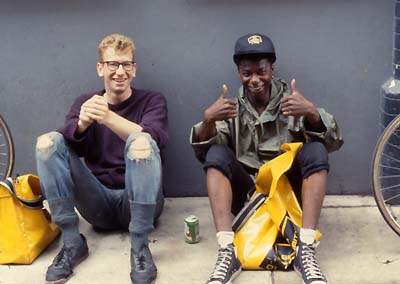 In most parts of
today's
Britain, racism is not
part of ordinary life. Most people do not judge other people by the
colour of their skin. Groups like the "English Defence League"British
National Party are very marginal, and do not usually
win any elections.
The most
ugly
forms of
racism, at least, have been rejected; and while Britain's
Blacks still have many forms of prejudice
to
fight against, vicious racism is not usually one of them.
In most parts of
today's
Britain, racism is not
part of ordinary life. Most people do not judge other people by the
colour of their skin. Groups like the "English Defence League"British
National Party are very marginal, and do not usually
win any elections.
The most
ugly
forms of
racism, at least, have been rejected; and while Britain's
Blacks still have many forms of prejudice
to
fight against, vicious racism is not usually one of them.
Nonetheless, although black and white
communities live side by
side in most British cities, and there are not usually visible
tensions
between ordinary people, from time to time serious racist
incidents take place.
The most notorious
of
these concerned a black teenager called Stephen Lawrence,
gratuitously
murdered in 1993 by a gang of white youths as he waited at
a bus stop. Almost every week, racist incidents are reported
in the
media, somewhere in Britain. Perhaps, in a population of over 60
million people, that is inevitable, even in a country where the vast
majority of people claim that they are not racially
prejudiced.
Yet there
are two sorts of racism: visible racism, and invisible
racism.
Many black people in Britain feel that
they are regularly
discriminated against in invisible ways. Unemployment
is
higher among ethnic minorities than among Whites, and black pupils do
not do as well at
school as Whites - often because the schools that they go to do not
have high academic reputations. (Asians
,
on the other
hand, people from India, Pakistan or China, tend to do better than
white
pupils).
Black community leaders
frequently complain about racism in the police, and
unfortunately, some of their complaints are justified. In
1999, an
official report into the (London) Metropolitan Police (the "Met"),
following the
murder of Stephen Lawrence, stated that "institutional racism" was
widespread throughout
the
police service. Almost 30 years after Stephen Lawrence was killed,
"institutional racism" still exists in some sectors, and in 2021 and
2022, the world of British cricket was rocked by accusations
of institutional racism.
Since the1990s, the Met
and other police forces in Britain have introduced tough programmes to
try to stop this form of invisible - though sometimes visible -
racism. Though there has been no serious violence in Black districts of
British cities for over twenty years, people have not forgotten the
violence
that occurred in several British cities in the 80's. Even today, there
is often tension just under the surface in parts of London,
where poverty, unemployment and other social problems are high, and
confidence in the police is very low.
Plenty of projects have been
started, to provide
jobs and
training to young Blacks in
the poorest parts of the cities. Some have been very successful, and
lots of Black teenagers do well at school,
then go to university or do something else interesting, and
become
successful. In 2026, the Conservative Party, once led by Winston
Churchill and by Margaret Thatcher, is lead by Black lady,
Kemi Badenoch; and Britain's deputy Prime Minister is David Lammy, who
has been a member of parliament for over 20 years. Badenoch and
Lammy are, nevertheless,
exceptions.
Most Blacks in Britain today still live in the cities, or in the poorer
districts of small towns. Sixty years after the first Afro-Caribbeans
were
first invited to come and work Britain, only a small
minority
of Britain's Black community have really integrated into the mainstream
of
society.
Section 3: YOUTH AND RACE
Generally speaking,
young Blacks and young Whites get
on
together better than
their parents' generation. A
recent
survey of teenage attitudes showed that 70% of British teenagers
consider themselves to have "no racial prejudice at all", while only 2%
admit to
being
racially prejudiced. The rest admit to being slightly
prejudiced. There are several reasons for this.
Firstly,
today's youth are growing up together, in a society which is much more
multi-racial than it was in the past. Many British
people aged over sixty never sat in a school classroom with
people
from different races; today, on the contrary, there are few
secondary schools in Britain that do not have at least a few Black or
Asian pupils. Today's British teenagers, whether they are Black, White
or anything else, share
a large
degree of common
experience. They have been through the same school system, they eat the
same food, they use the same social media, and to a large
extent, they
like the same music. In short, most young people in Britain today share
a
similar - though certainly not identical - culture, whatever the colour
of their skin. Hopefully, that can only result in even better race
relations among future generations.
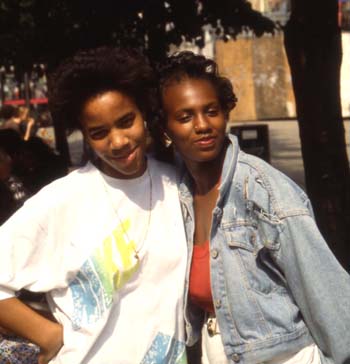 Generally speaking,
young Blacks and young Whites get
on
together better than
their parents' generation. A
recent
survey of teenage attitudes showed that 70% of British teenagers
consider themselves to have "no racial prejudice at all", while only 2%
Generally speaking,
young Blacks and young Whites get
on
together better than
their parents' generation. A
recent
survey of teenage attitudes showed that 70% of British teenagers
consider themselves to have "no racial prejudice at all", while only 2%
EQUAL OPPORTUNITIES?
In 2008, Americans chose Barack Obama, a black American, as president. In the USA black policemen are common: so are black politicians, black mayors, black Marines, and to a lesser extent black businessmen.In Britain however, there are still many professions in which Blacks have not yet managed to make much progress.
Although people from ethnic minorities about 14% of the total British population, you won't often see a black policeman, or a black Royal Marine. For many reasons, Blacks have found it hard to enter a number of professions; and once in these professions, they often find it harder to get promoted than white people.
In 1981 40% of Britain's Whites worked in professional, managerial or clerical jobs, only 13% of Blacks held similar jobs.
 Black people have however long held important positions in
British life; in the early 2000s, the most trusted TV newsreader was at
one Trevor
McDonald,
the anchor of ITV's popular "News at Ten" programme; and on
the BBC, Moira Stewart, also black, was one of the most popular
newsreaders. In 2026, one of thee BBC's top (and most trusted) news
presenters is Clive Myrie.
Black people have however long held important positions in
British life; in the early 2000s, the most trusted TV newsreader was at
one Trevor
McDonald,
the anchor of ITV's popular "News at Ten" programme; and on
the BBC, Moira Stewart, also black, was one of the most popular
newsreaders. In 2026, one of thee BBC's top (and most trusted) news
presenters is Clive Myrie.Many British employers now officially label themselves "Equal Opportunities Employers"; police forces are trying hard to recruit more black officers, and the number of black doctors and lawyers is slowly but steadily rising, as a growing proportion of black teenagers go on to university, and qualify for better jobs.
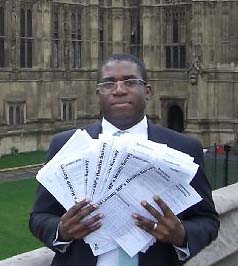
In 2022 there were sixty-five ethnic minority MP's in the House of Commons, eight of them black. They included David Lammy (photo right), who was brought up as a child in a poor quarter of London. Some people say that he is one of the brightest M.P's in the Labour Party... and possibly Britain's first black Prime Minister.
BLACK MUSIC
Black music has
done more
than most things to bring Black and White cultures together.
Almost the
whole of today's rock and pop music has its roots in Black music: rock
'n' roll, the base of today's pop, developed out of the jazz
and
rhythm 'n' blues of Black America. England's Blacks, however, have
added their own specific contribution to contemporary pop
music, in particular through reggae music, the music
of the
West Indies.
Reggae came to England in the late 60's
through
an innovative
record
company called Island Records. Island soon helped lots
of black bands from the West Indies and from Britain, led by Bob
Marley,
to become popular with British youth of all backgrounds
.
Other record companies soon followed, and began signing
up
other Black bands.
 Before long, black British musicians were regularly
finding themselves in the Top Ten, while white bands played more and
more "black" music, and an increasing number of bands
recruited
musicians regardless of their colour.
Before long, black British musicians were regularly
finding themselves in the Top Ten, while white bands played more and
more "black" music, and an increasing number of bands
recruited
musicians regardless of their colour.
Today, the world of music is one
of the ways that young British Blacks dream of as a route to
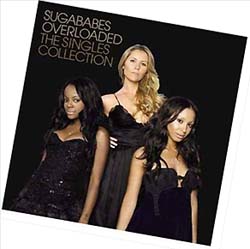
success. The band Sugarbabes
- two black, one white - is the most successful British girl group of
the 21st century – so far. Only a very small minority
succeed, of course, in
reaching the top, but in the world of music, as in the world of sport,
the doors to success are certainly open. More importantly though, the
virtual absence of "race" as an issue
in
most sectors of
the music industry today (in Britain at least) has helped to
bring
young people of all colours together in a common culture and a
common heritage that all recognise as their own.
SPORT
Sport is
another
sector
in which black British stars have done a lot to improve race relations.
When, in the 1980's, the first black footballers were signed
up by
top British football clubs, they met serious discrimination and
sometimes hostility from the fans. Since then, clubs have
tried
hard to eliminate racism from the game, and
generally they have succeeded. Former Arsenal star, Ian Wright, is said
to be one of the most influential people in Britain today.
Today, with all but a bigoted
minority
of fans, Britain's great black footballers enjoy the same status as
their white team-mates. The same is true in athletics; and everyone in
Britain knows that without its black athletes, Britain's sports teams
would not be as successful as they are.
WORD GUIDE
appeal to: attract - Asians: (here) people from Asia - background: origin - bigoted: having extremist and fixed opinions - bitter: strong, nasty - boil over: reach a point of crisis - clerical: in an office - conductor: man selling tickets - contingent: group - decade: period of ten years - enjoy: benefit from - former: who used to be... - get on: live - gratuitously: for no reason - hardly: almost not - improve: get better - innovative: with new ideas - issue: problem - lawyer: man in the legal profession - MP: Member of Parliament - misguided: manipulated, wrong - nevertheless: all the same, however notorious: well known for the wrong reasons - overt: clearly visible - poverty: being poor - prejudice: fixed and irrational opinions - prosecute: attack in a court of law, sue - provide: make, create recruit: start to employ, find - riot: rebellion, violence - rivalry: competition - settle: establish a home - share: to have in common -signup: give a contract to - status: position - throughout: in all parts of - tract: brochure, sheet of paper - ugly: unpleasant, nasty - unemployment: not having any job - vehemently: with force - views: opinions
Copyright © Linguapress. Do not copy this document to any other website
Copying permitted for personal study, or by teachers for use with their students.
Student worksheet
Black and British
Here is a résumé of section 1 above. Fill in the blanks, using information from the article.Most of the words that you need can be found in the article. In some cases, the first letter of a word is given, to help you.
At first young men came , many of them from the West ; and before long they brought their families over . Within ten years, there were large Afro-Caribbean in several British cities.
Although these new lived in the poorer parts of the cities, they had paid jobs, and they often enjoyed conditions that were better they had known in the West Indies.
about 1967, there was racial tension, because there was work for everyone, and the new immigrants did the jobs that workers did not want to do. But then, following the success of the Rights movement in the USA, Britain's Blacks began demanding . conditions.
Some right- politicians became alarmed at the number of Blacks in Britain, and said that they be sent back to where they had come from; at the same time, there were the first cases of racial tension, as the problem of began to spread. Some extreme right- parties appeared, xenophobia and racism; but these parties, such as the National Front and the British National Party, were never very
Today Britain is still generally a country, even if there are a racists here and there.
Section 2:
TODAY IN BRITAIN
Grammar: Quantifiers:
Section 2 contains a lot of "quantifiers"; such as most, many, few, several, a small minority, etc. There are three main groups of quantifiers:
for example: most people, but most of the people, some complaints but some of their complaints,
b) those which are always followed by of, such as plenty, none, the majority,
and c) those that are never followed by of, such as no, every.
► To learn all about quantifiers, see A Descriptive Grammar of English pages 102 to 114 (ebook or paperback)
Add in the word OF in the following sentences, whenever (and only when) necessary:
2. Some men brought their families with them.
3. Few the men who came had been to Britain before.
4. There were few cases of racial tension in the 1950's.
5. At the time there were plenty jobs for everyone.
6. Not many black workers found well paid jobs.
7. Several the worst racist incidents took place in London.
8. Anti-racism programmes have been introduced in several police forces.
9. There are many different forms of racism.
10. Most the black people in Britain still live in cities.
Section 3
True or false?
Which of these statements are true, and which are false?
2. Bob Marley recorded with Island Records. T / F
3. Music is one of the easiest ways for young black people to achieve success in Britain. T / F
4. Race is not usually an issue in the music industry. T 1 F
For teachers:
Classroom presentation:
This File is fairly concentrated in facts. The background article (part 1) is particularly concentrated in this respect.
Read through sections 1 and 2 with your class, checking that students understand the meaning of words and sentences; then use one or other of these sections as the basis for an oral gap-fill exercise.
Read the article quite slowly, pausing at factually strategic points, and asking pupils to complete the sentences providing the necessary information, though not necessarily using the same words as the original. Here is a part of section: the | symbol marks spots at which you should pause.
Hundreds of thousands of young men had | been killed during the war; who could take their place?
There was an easy answer; | men from the colonies!
Britain was still the capital of an Empire that stretched to | the four corners of the earth. In the developing countries of the Commonwealth, there were millions of | young men, just looking for work. When the British authorities offered them the chance to come to Britain and work, | | thousands jumped at the opportunity.
Most came without | their families; but soon, as they settled into their new country and their new | jobs, they| paid for their families to | come over too. While a few came from Africa, the largest contingent of Black immigrants came from | Jamaica and the other islands that make up theh | West Indies.
By 1960, "Afro-Caribbeans" and their families had settled in large numbers in several of Britain's cities — usually in the | poorest and most unattractive parts.
Quantifiers exercise, (section 2)
Answers.
True/False exercise, (section 3):
Answers.
Other ideas?
EFL / ESOL teachers: Help develop this resource by contributing extra teaching materials or exercises.
To contribute click here for further details
This teaching resource is © copyright Linguapress renewed 2026.
Republication on other websites or in print is not authorised
| Linguapress home | English grammar | Discover Britain |