

California's Water Wars
A matter of survival
Linguapress
Linguapress Advanced
English
Environment
by Larry WoodLarry Wood, an award-winning writer on environmental affairs, wrote this original article for Linguapress back in the 1990s. A quarter of a century later, the problem has not gone away. On the contrary, it's getting worse on account of climate change, as summer droughts and temperatures reach levels that they have never reached before
Water .......
 This
five-letter word is one that
Californians see almost daily in headlines.
This
five-letter word is one that
Californians see almost daily in headlines. How to dam it, how to sell it, how to use it, how to share it, how to keep it pure.... these are just a few of the major problems that face California's people and political leaders.
Thousands of dollars are spent annually on studies, and on lawsuits, in California's "Water Wars", and the seemingly endless conflict between the overwhelming needs of Central and Southern California, and their drain on Northern California rivers.
California has what has been called "the biggest waterworks in history". Dams in the Sierra Nevada mountains hold back water provided by great rivers fed by rain and snowmelt; they tame raging rivers, help prevent damaging floods, generate cheap, pollution-free hydro-electricity, and release a steady supply of water for California's citizens.
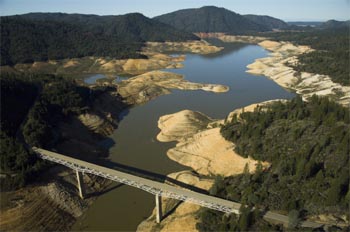
California's great cities get their water via an immense network of dams, aqueducts, pipelines and wells that is one of the engineering wonders of the world. Part of the water supply for the Los Angeles area comes from a 445-mile long canal (photo top of page) running south from the "Delta" area of Northern California. During its long journey, the water is pumped up a 3000 ft. elevation, then enters a tunnel through the mountains, before reaching the Los Angeles area. More water for this thirsty area is brought in along the Colorado River Aqueduct, over a distance of 185 miles; and the City of Los Angeles also takes water from a place called Owens Valley, 338 miles away!
Even the city of San Francisco, in cooler Northern California, has long-distance water, its supply being carried almost 150 miles from an artificial lake in Yosemite National Park.
Yet mammoth as this interlocking system is, it is inadequate to handle the state's rapidly growing population. The prospect of major water problems in the near future has become particularly alarming.
Many California farmers have already had to abandon crops on account of water shortages during recent dry summers; and in many towns and cities, the sprinklers that traditionally keep the lawns green round suburban homes have been turned off. .
As if dry summers and growing needs were not enough problems already, Californians also have problems getting water from outside their state. For instance, the Colorado river.provides water to several states, and also to Indian reservations, and there has been a lot of argument about water rights. In 2003, the state of California agreed to take a smaller quota of water from the Colorado River - partly to allow the state of Nevada to have more, on account of the dramatic increase in needs of the city of Las Vegas.
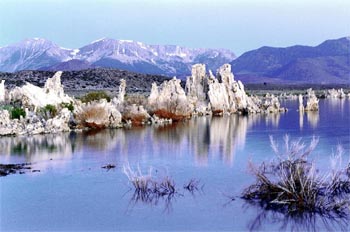 One of the most
serious environmental problems was that
of Mono Lake. In 1989, California's State Legislature voted
$65
million to find alternatives to save Mono Lake from evaporating in the
desert sun of Eastern California. Since then, the depletion of this
unique environmentally-sensitive lake has been reversed, and though the
water level today is still some 35 ft. below the natural
level
recorded back in 1941, it is now 10 feet higher than it was at its
lowest point, in 1982.
One of the most
serious environmental problems was that
of Mono Lake. In 1989, California's State Legislature voted
$65
million to find alternatives to save Mono Lake from evaporating in the
desert sun of Eastern California. Since then, the depletion of this
unique environmentally-sensitive lake has been reversed, and though the
water level today is still some 35 ft. below the natural
level
recorded back in 1941, it is now 10 feet higher than it was at its
lowest point, in 1982. Since the year 2000, California has had a series of drought years with below normal rainfall. Emergency water conservation ordinances have made lawns turn brown, cars and sidewalks get dirty. Violators of the ordinances have had their water supply cut to a trickle. In Fresno, a city which does not even meter how much water its residents use, the wells have already run dry..
Water conservation measures are part of the answer; but political analysts predict that it will require many years and some serious and unattractive lifestyle changes to resolve California's Water Wars. The tense competition for a scarce resource, among groups with conflicting interests, will demand give and take forever.

WORDS :
Dwellers: residents - lawsuits: legal battles - overwhelming: enormous - dam: barrage - tame: conquer - mammoth: enormous - prospect: image - blow: bad news - lawn: grass - trickle: a very small flow - meter: to count - drought - period with no rain or very little rain - well: hole in the ground from which a liquid is taken - give and take: compromise.
Updated 2023 from an article in Spectrum magazine, by Larry Wood.
Professor Larry Wood is a prizewinning freelance environmental journalist, based in California.
Discover more advanced reading texts on environmental issues.
Copyright © Linguapress. Do not copy this document to any other website
Copying permitted for personal study, or by teachers for use with their students
LINGUAPRESS ADVANCED ENGLISH - STUDENT WORKSHEET
California's Water Wars - Exercises:
Memory & logic cloze exercise: Fill in the blanks in this extract from the text, using the qualifiers (adjectives, etc.) listed: you can slide, or copy and paste, words from the list into the boxes, which will expand to take your text. You will probably need to refer back to the original article above to look for many - if not most - of the answers. To save your completed text, you can copy and paste it into another document or social media post.
alarming / artificial / cheap / cooler / engineering / great / growing
/ immense / inadequate / interlocking / long-distance / mammoth / major
/ near / particularly / pollution-free / rapidly / thirsty / water /
water
/ 445-mile long / 3000 ft. / of 185 miles / 338 miles away.
California's cities
get
their water via an
network
of dams, aqueducts, pipelines
and wells that is
one of the
wonders of the
world.
Part of the
supply
for the Los Angeles area comes
from a
long
canal running south from the
"Delta" area of
Northern California. During its
journey, the water is
pumped up a
elevation, then
enters a
tunnel through the
mountains, before reaching the Los Angeles area. More water for this
area
is brought in along the Colorado
River Aqueduct,
over a distance
; and the City
of
Los Angeles also takes
water from a place called Owens Valley,
!
Even the city of San Francisco, in Northern California, has water, its supply being carried almost 150 miles from an lake in Yosemite National Park.
Yet as this system is, it is to handle the state's population. The prospect of problems in the future has become .
Even the city of San Francisco, in Northern California, has water, its supply being carried almost 150 miles from an lake in Yosemite National Park.
Yet as this system is, it is to handle the state's population. The prospect of problems in the future has become .
Going further: Creative writing. Write down the potential consequences of changing rainfall patterns, both direct and indirect. Draw up a contingency plan for your area, should your own water supply be threatened.
Another idea for creative writing: Produce projects for authentic documents (in English) for distribution to the public. Try to achieve maximum realism in this task.
Teachers:
General lesson plan. See model reading lesson plan ideas.Introduction. Water is one of the biggest problems facing humanity. It does not just affect the USA, but the whole planet. Climate change means that in some places there is too much water, in others not enough. Four-hundred-mile pipelines can help in some places, but they arenot the main answer to the problem. What other solutions can your students suggest? Are they practical? Are they affordable?
Challenge your students! The vocabulary-based cloze exercise above is deliberately diffficult. It is not just a simple testing exercise designed to check how much vocabulary students have acquired (as used for the purposes of testing in Cambridge and other exams), this type of cloze exercise is a learning activity designed to make them read a text word by word, understand how words are used together, remember them, and what they mean.
© linguapress.com
More grammar : For a clear presentation of English Grammar, discover A Descriptive Grammar of English, published by Linguapress, and available as an ebook, hardcover or paperback from Amazon worldwide, from Barnes & Noble in the USA or Waterstones in the UK, plus other good bookshops..

 Copyright
information.
Copyright
information.