
From smugglers to people traffickers -
old activity, new phase
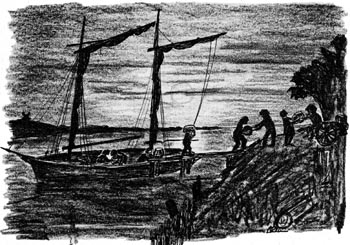 March
28th 1690. It is dead
of night; in the small creek near Dymchurch, a village on
Romney Marsh, a
dark boat approaches a well-hidden landing stage.
It moves noiselessly
across the water, slows down, and ties up. Immediately, but without a
sound,
some thirty figures emerge from the bushes and approach the water. A
horse and
cart appear from nowhere, and the work begins. In the space of quarter
of an
hour, the boat's cargo is totally unloaded,
carried up the bank and
loaded onto the cart, and onto another one that follows it. Twenty
minutes
later, the boat, with darkened sail, is turning round and
heading back out to
sea whence
it had come. Its cargo, a hundred barrels of finest cognac,
is on
its way to a hiding place, for later dispatch to
London.
March
28th 1690. It is dead
of night; in the small creek near Dymchurch, a village on
Romney Marsh, a
dark boat approaches a well-hidden landing stage.
It moves noiselessly
across the water, slows down, and ties up. Immediately, but without a
sound,
some thirty figures emerge from the bushes and approach the water. A
horse and
cart appear from nowhere, and the work begins. In the space of quarter
of an
hour, the boat's cargo is totally unloaded,
carried up the bank and
loaded onto the cart, and onto another one that follows it. Twenty
minutes
later, the boat, with darkened sail, is turning round and
heading back out to
sea whence
it had come. Its cargo, a hundred barrels of finest cognac,
is on
its way to a hiding place, for later dispatch to
London.The smugglers have succeeded again; as they usually do. For in this part of south east England, smuggling is a lucrative business, and has been so for centuries. In fact, in the seventeenth century, it is one of the most profitable professions in the region.
From the eleventh to the eighteenth century, cross-Channel smuggling was a busy activity, providing a living for hundreds of people round the English coast. It began in serious shortly after the Norman conquest of England in 1066, when William the Conqueror brought over thousands of his men from France. They brought with them a taste for French wine and other continental products, and these tastes soon spread among the English population.
To supply their own tables and those of their courts, the Norman kings imposed a duty on imported products, taking a percentage of everything that came in. It was to avoid this loss that smuggling first developed.
Long before the seventeenth century, smuggling had become a major industry; and indeed, until this period, there was virtually nothing that could be done to effectively stop it. Tax collectors, or revenue men, were not generally well respected people in those days, and whole communities, from the local priest to the ordinary folk, would work together to outwit any officials who came along
The eighteenth century saw the climax of the smuggling trade; it also saw its worst horrors. During this century, when Britain really began to expand as an inter-national trading nation, the rise in imported goods was spectacular; so too was the rise in the number of different products on which the government imposed taxes. Tea, coffee, silk, spices, tobacco, and other luxuries from round the world; all became subjected to sometimes very high dues.
With so much at stake, it was not surprising therefore that smugglers went to great lengths to ensure that their operations ran smoothly. Armed gangs of men were paid to keep the King's officers well away from what they were looking for. They did not hesitate to beat up, or even torture or kill those who tried to get in their way; and customs officers soon realised that it was not in their interest to intervene, unless they wanted to come to a sticky end.
It is estimated that three quarters of the tea imported into England at one stage was brought in by smugglers.
It was Napoleon, in the end, who brought the great age of English smuggling to an end. Fear of invasion from France led the government to establish a permanent watch round the south east coast of England, a watch which later developed into the Coast Guard service. Confronted with this alert and respected force, smugglers were no longer able to go on ruling the roost as they had done for so long; and subterfuge and cunning came to replace force and threats. From then on, organised smuggling became a minor activity, perceived more and more as a criminal activity like any other.
Of course, smuggling has never stopped, and today there are still active smugglers in operation; their methods, however, have changed. From time to time, the odd small boat still comes in furtively to a small English harbour, to discharge a cargo of brandy, or more likely drugs or arms; but most contraband now comes in hidden in personal luggage, or in legally imported consignments of goods; containers from Columbia, or trailers from Turkey, for instance
.
The people traffickers
In the event, the worst form of modern smuggling across the Channel is the smuggling of human contraband – "people trafficking" as it is often called. The last twenty years have seen a massive increase in the number of people from distant countries trying to enter Britain illegally. They come from Africa, from Iraq, from China, from Afghanistan, from all over the world.... some speak a couple of words of English, others speak good English, and they all imagine that a life in Britain will be their Eldorado.But the dream is usually just that: a dream, nothing more, and the reality that follows can come as a shock.
The people who are trafficked into Britain have no visa and have paid large sums of money to criminal gangs to bring them over. Some reach Britain hidden in the backs of lorries; many more come across the English Channel from France, piled into flimsy rubber zodiacs. Sometimes they make it across to the English coastline; but for many of the would-be immigrants, even those who manage to enter Britain without being caught, the life that awaits them in Britain may be dangerous and miserable.
Most "illegal immigrants" are picked up and taken to detention centres. While some may get accepted as political refugees, many can only hope to live a life in the shadows, hiding from the authorities, hoping that no-one will discover them. At worst, they will end up in a life of misery, exploited as virtual slaves by the gangs that brought them to England in the first place. Many men are used as cheap labour, little paid, and living and working in bad conditions. Some young women get forced to work as prostitutes. At best, illegal immigrants face a life in temporary accommodation while they await news about their application to remain in the UK.
While the nature of smuggling has changed, the customs men still remain vigilant. So do the coast guards. The fight against smugglers may not be the same as it once was; but if the coast guards ceased to exist, the door would be open to the new age of smuggling. It is certain that th criminal gangs who make millions from people trafficking would quickly make the most of it!
WORDS:

to traffic, trafficking: to transport illegally - lucrative: profitable smuggle: to import/export contraband -landing stage: small jetty, place where people can get out of a boat - unload: discharge - whence - from where - dispatch: send - lucrative: profitable - supply: provide - duty: tax - climax: highest point - stage: point - watch: guard - cunning: clever, astute - the odd: the occasional - in the event : in reality -Eldorado : land of gold - would-be: hopeful, wanting-to-be - flimsy: light-weight and not very strong - labour: workers
Updated from an article originally published in Spectrum magazine.
Printing: Optimized for printing.Copyright © Linguapress renewed 2022. Do not copy this document to any other website
Copying permitted for personal study, or by teachers for use with their students
LINGUAPRESS ADVANCED ENGLISH - STUDENT WORKSHEET
SmugglersComprehension:
Explain the meaning of the italicized expressions in the article; then make up sentences reusing the same expressions in entirely different contexts.
Descriptive narrative writing:
Imagine that you are a customs officer in 1700 ; you are watching the scene shown in the picture. Write a report next day, as a first person preterite narrative, describing what happened, what was being smuggled, and what you did.
Interactive: Text correction:
Correct the mistakes in this badly copied extract from the article.
The copy below is editable, i.e. you can make changes to it directly on your computer screen.
Do this exercise with or without consulting the original article. If you compare the two texts, this is an exercise in careful reading (a highly useful exercise!); if you look at the text below without looking at the original article, it will be an exercise in grammar, memory and logic. The second variant of this exercise can usefully done by students working in pairs; you will need to argue with each other in order to reach agreement over what is wrong, and what the original text actually said.
Interactive:
Prepositions and adverbs:
Replace the missing
prepositions and adverbs in the following extract from the article. In
particular attention to the word as
which is used as used as a preposition four times in this extract.
© linguapress.com

 Copyright
information.
Copyright
information.