
Advanced level English
Environment and wildlife
Interview: the Bird-Man of the Isles
A hospital for birds on the Scottish island of Skye
Andrew Rossiter talks to Graham Ross, who runs a one-man wildlife hospital on the wild and beautiful Scottish island of Skye.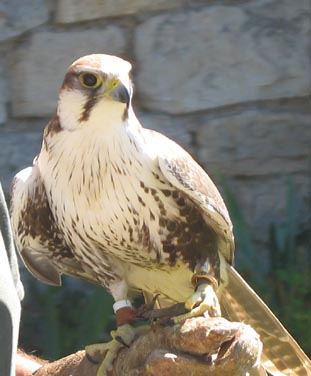
- ANDREW:
Graham; people call you the "bird man of the Isles"; so can you tell me
what exactly is
it that you do with birds?
- GRAHAM: Well I take in injured birds, mainly birds of prey; I fix them, and hopefully return them to the wild. These injuries would be broken wings, or starvation, or whatever.
- Are there a lot of birds of prey on the Scottish isles, or are there less than there used to be?
- The Scottish islands are still a stronghold for a lot of birds of prey. There are probably as many as there ever were.
- When you get a bird in, what do you do to it? Do you keep it in a bird's hospital, or do you send it out to a doctor? Or are you the doctor yourself?
- I'm not the doctor! But the veterinary surgeons here tend to be more acquainted with sheep and cattle, rather than birds. And I tend to look after the bird side of it. In fact, some of the veterinary surgeons here refer patients to me!
- You get in falcons and eagles here! How does an eagle manage to get here? How do people find eagles to bring to you?
- Somebody'll maybe come across an injured eagle, for example, on the hill; and report it to somebody. And more often than not it's the police that contact me and tell me there's an injured bird, eagle or whatever, at such and such a place. And I usually go for it if it's an eagle, but if it's something like a smaller bird, I ask people just to put a box over it and bring it to me.
- Do all the birds you have come from the island of Skye? Or do people bring them in from further afield?
- All the ones I have at the moment come from the Isle of Skye. I have had them from further afield; from the mainland of Scotland, and from some of the other islands nearby.
- And after you've had a bird, what do you do with it? Do you release it into the wild? And if so, how many of your birds can you release into the wild? Or do you have to keep some of them because they're unable to fly?
- The majority of the birds are released back into the wild. I do have some that over the years I've had to keep, because they were unable to fend for themselves in the wild..
- Are there a lot of people doing this kind of rescue work for birds of prey in Scotland? Or are you one of the few?
- There are a few throughout Scotland; and most areas are covered by somebody who will take in birds and attend to them as best as possible.
- Is the situation for birds of prey or eagles still getting worse, or is it improving in this part of the world, would you say?
- I think compared to the situation in the sixties, when they had a pesticide problem, the situation is improving.
- Would you say it's going to go on improving? Or have we reached a sort of equilibrium now?
- As far as Skye's concerned, I think probably that the numbers of birds of prey are about as high as we could expect; as high as the habitat will stand.
- You sometimes breed birds, I believe, in particular owls. What do you do with these? Do you put them back in the wild, or do you send them to other parts of Britain, or what?
- We've been breeding barn-owls for several years now, and we release them into the wild on Skye.
- Have you got any plans to breed any other types of bird?
- No plans immediately. It just depends on what I might have; and if I had a pair... the buzzard*, for example. There's no point in breeding buzzards; they're so common. Peregrine*; there's not many peregrines in the area, but to breed them and release them could improve the natural stock. But I think they're doing quite well naturally, and I think if they reach their own levels, that's quite sufficient. Kestrels*, sparrowhawks* are fairly common throughout Skye and the country, so there's no point in breeding them.
Andrew Rossiter was chief editor of Linguapress Magazines
WORDS

bird of prey: carniverous bird; these include hawks, falcons and eagles - the wild: nature - vetinerary surgeon: vet, animal doctor - be acquainted with: be familiar with, know about - starvation: having nothing to eat - release: let go fend for themselves: live without help - attend to: help, pay attention to - stand: support - breed: reproduce.
* Kestrels, buzzards, peregrines and sparrowhawks are four different types of birds of prey found in Britain and Europe.
Printing: Optimized for printing
Copyright © Linguapress. Do not copy this document to any other website
Copying permitted for personal study, or by teachers for use with their students
STUDENTS' WORKSHEET
The Bird man of the Isles
Comprehension: true or false?
Interactive: Read through these true/false statements, then listen to the interview and try and answer them:- Graham Ross sends as many birds as possible back to nature.
- There are more birds in Scotland now than ever before.
- Vets on Skye are more specialized in large animals.
- The only birds that Graham actually goes out to get are eagles.
- People send birds from all over Britain to Graham Ross.
- He only keeps weak birds.
- The environmental situation has improved since the sixties for birds.
- There are not enough birds of prey on Skye.
- Barn owls are released after several years on the island.
- It is impossible to breed Peregrine Falcons in captivity
For teachers
Grammar: Do as an auxiliary, notably in questions.
This interview is particularly useful for showing how do is used as an auxiliary verb in questions without a question word. However, do is also used in this interview as a main (lexical) verb, for example in the very first question: what exactly is it that you do with birds?
Note in particular the uses of do in the third question: When you get a bird in, what do you do to it? Do you keep it in a bird's hospital, or do you send it out to a doctor?
The fifth question is interesting, as it shows how a long subject, including a relative clause (without a relative pronoun) can come between the auxiliary do and the main verb:
Do all the birds you have come from the island of Skye?
Classroom activity - Pair work, oral:
Have students recreate this interview in their own words, working in pairs. In each case, the student taking the role of the interviewer should read the questions, the other student answer them as best as he can.
Writing: Imagine that this interview is to be used as the basis for an article , and write this article in 400 words or more..
Discussion: perhaps you have some keen ornithologists in your class; if so, get them to talk about the questions raised by this interview.
©

 Copyright
information.
Copyright
information.